The Price of Responsibility: The Impact of Health Reform on Non-Poor Uninsureds

This post was originally published for the Health Policy$ense blog of the Leonard Davis Institute of Health Economics.

While the Affordable Care Act has achieved a second victory before the Supreme Court and produced significant coverage gains, it might also have produced a less positive outcome: in an NBER working paper, Penn LDI colleagues Mark Pauly, Adam Leive and Scott Harrington found that a large portion of non-poor (measured by income above 138% of the poverty level) who gained coverage now have a higher financial burden and lower welfare (well-being) than when they were uninsured. The authors call this extra burden a “price of responsibility” for complying with the individual mandate to purchase coverage.

To evaluate the change in financial burden and welfare, the authors compared the out-of-pocket payments made by uninsured people before the ACA with premiums and out-of-pocket payments made after gaining coverage. The authors also estimated the positive effects of health coverage, such as higher use of services and protection from catastrophic medical bills. Even so, the model found that non-poor adults who went from uninsured to insured were paying higher premiums (even with subsidies) and, surprisingly, more out-of-pocket fees. While the burden was lower for those with lower incomes, because of subsidies for premiums and co-pays, the burden across all levels of income was positive – meaning that the average non-poor adult who gained insurance under the ACA had a higher financial burden after purchasing insurance.

The authors estimated that subsidy-eligible people with incomes below 250% of the poverty threshold likely experience welfare improvements that offset the higher financial burden, depending on assumptions about risk aversion and the value of consuming more medical care. However, even under the most optimistic assumptions, close to half of the formerly uninsured (especially those with higher incomes) experience both higher financial burden and lower estimated welfare.

Stated succinctly:

“Persons with low incomes may fare better after the ACA, but those formerly uninsured at higher incomes not in poor health consistently are worse off.”

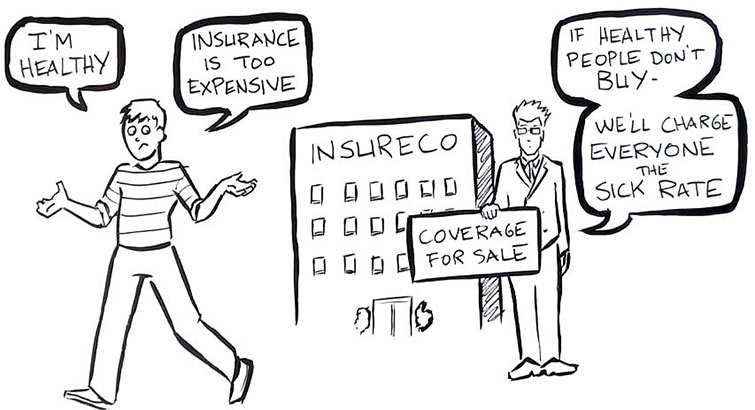
The implication here is that middle class people with low perceived health risk might prefer to remain uninsured and pay the penalty for violating the individual mandate. Reluctance among healthier and higher-income uninsureds is no surprise, but this paper appears to be the first to robustly measure the actual trade-off they would have to make in purchasing insurance.

Given that insured people use more than twice as much health care as uninsured people, it is not so hard to imagine that formerly uninsured people now have more responsibility for premiums and co-pays. But how did the authors conclude that the upsides of insurance – risk protection and actual services – are not enough to outweigh the financial burden and create “positive welfare” for newly insured people?

One reason is that most of the formerly uninsured were receiving some amount of free care (“bad debt” or “charity care”) before the individual mandate took effect. What’s changed is that people are on the hook for premiums and co-pays to receive that same care, plus other services that might not have been provided for free. The authors acknowledge that, for individuals who are low-income or at a high risk for expensive care, purchasing insurance can lead to improved welfare from additional health care services. Looking out across the entire group of uninsureds, though, the benefit of additional health care services does not appear to outweigh the increased financial burden, even with subsidies.

The surprising findings have sparked reaction from across the economic blogosphere. Matthew Martin from Separating Hyperplanes proposes one explanation: “the ACA is especially goofy in that much of the redistribution is confined to within the new individual market – even though people with employer-sponsored coverage are generally both wealthier and healthier. We have community rating within large employers and within the new individual market, but there’s no mechanism to redistribute between each of these pools.”

Writes Tyler Cowen from the blog Marginal Revolution: “I’ve read so many blog posts taking victory laps on Obamacare, but surely something is wrong when our most scientific study of the question rather effortlessly coughs up phrases such as […] ‘Average welfare for the uninsured population would be estimated to decline after the ACA if all members of that population obtained coverage.”

He continues, “the best thing to do is to improve it from within. Still, there are good reasons why it will never be so incredibly popular.”

For their part, Pauly, Leive and Harrington conclude: “It will be important to examine the level and pattern of these increased financial burdens to judge whether they are of sufficient social value to justify their imposition.”

Patient-Centered Medical Homes and Appointment Availability for New Patients

This post was originally published for the Health Policy$ense blog of the Leonard Davis Institute of Health Economics.

Enhancing access to primary care is a key component of a patient-centered medical home (PCMH). But little is known about how PCMH status affects the availability of appointments for new patients. In a new analysis of “secret shopper” data, LDI Senior Fellows Jaya Aysola, Karin Rhodes and Daniel Polsky found that PCMHs were 1.26 times more likely to offer a new appointment and 1.36 times more likely to schedule an after-hours appointment than other primary care practices, with no differences in average wait time for a new appointment.

The data were collected in 2012-2013, prior to full implementation of the Affordable Care Act. Trained field staff placed more than 11,000 phone calls to more than 7,000 primary care practices across 10 states, posing as new patients seeking a primary care appointment. Previously, findings from the study showed differences in the likelihood of scheduling an appointment by type of insurance, and the important role played by federally-qualified health centers and rural health clinics in assuring appointment availability to Medicaid patients.

While just 5% of practices in the study were PCMHs, the difference in new appointment availability may take on increased importance as the model is more widely adopted and as millions of non-elderly adults gain coverage through the ACA.

Why might PCMHs have more new patient appointment availability than other practices? It could be simply because they make a concerted effort to make access to appointments easier, as part of their overall policies on enhanced access to care. Beyond this, the data are silent. Another hypothesis is that the efficiencies created by PCMH processes may allow for greater patient panel size. There is debate, however, on whether these efficiencies will instead be applied to improving the care for existing patients. The authors note:

Some believe that PCMH will expand panel sizes and assert that global payment schemes would naturally incentivize this over fee-for-service models. Others expect that PCMH practices will keep panel sizes low and increase the intensity of services provided to existing patients, by lengthening patient visit times to improve the quality of care and minimize provider burnout.

The study did find differences in average daily census per physician between PCMH practices and non-PCMH practices. Most physicians in both PCMH and non-PCMH practices saw an average of 20-­39 patients daily, but fewer PCMH providers saw more than 40 patients daily than those in other practices. However, the study found no significant relationship between average physician daily patient census and access to new appointments, and so the question remains an open one.

The PCMH model: what we know

Patient Centered Medical Homes (PCMH) are primary care practices that are accredited by the National Committee on Quality Assurance (NCQA) according to a set of standards that focus on enhancing access and continuity of care, identifying and managing patient populations, tracking and care coordination, providing effective care management, self-care and community support, and measuring and improving performance.

The PCMH model is still in its infancy; the NCQA proposed operational standards for recognizing practices as PCMHs in 2008. Given the time needed for “practice transformation,” and the wide variation in performance on the scale that the NCQA uses to evaluate PCMH-certified providers, comprehensive and reliable evaluations have been difficult to conduct.

A 2013 systematic review found evidence of a small positive effect on patient experiences and  delivery of preventive care services, but concluded that current evidence is insufficient to determine effects on clinical and most economic outcomes.

A recent study by Aysola and colleagues found that most patients enrolled in PCMHs within the University of Pennsylvania Health System didn’t even know that they were in a PCMH. Patients uniformly lacked awareness of the PCMH concept, and the vast majority perceived no PCMH-related structural changes, regardless of the degree of practice-reported PCMH adoption.

As the PCMH model spreads and evolves, and providers are able to move past meeting a list of standards and move toward meaningful transformation – in areas such as appointment flexibility, care coordination and remote support –more useful data on PCMH performance and outcomes should emerge.

The Elusive Digital Doctor: Interview with Dr. Bob Wachter

This post was originally published for the Health Policy$ense blog of the Leonard Davis Institute of Health Economics.

Along with being Interim Chair of the Department of Medicine at the University of California and ranked by Modern Healthcare as the most influential physician-executive in the U.S., Robert Wachter, MD, is the author of 250 articles and 6 books, the latest of which has become a New York Times Best Seller. Entitled The Digital Doctor: Hope, Hype and Harm at the Dawn of Medicine’s Computer Age, the book is being hailed across the country as the most compelling one yet written on its subject.

The Digital Doctor, which was the subject of Dr. Wachter’s recent talk at the University of Pennsylvania’s Leonard Davis Institute of Health Economics (LDI), explores a dramatic, real-world case in which a child received a 38-fold overdose of a common antibiotic. Wachter uses that example to illustrate some of the unforeseen consequences of health IT and how it is influencing all aspects of health care. We spoke with him about the accomplishments and unexpected consequences of health IT, the process of writing the book, and new ideas that might deserve more attention from health care leaders and policymakers.

Imran Cronk: How did your views on the pitfalls and promises of health IT change or evolve during the research, interviewing and writing process for this book?

Robert Wachter: My passion for writing this book was drawn from my own experience, which was terrifically disappointing. That came from a lot of angles: my own experience clinically, my   work in patient safety, and from seeing the way IT seamlessly fixed all the other problems in my life. I thought, “Health care is dysfunctional and clunky. I need to understand what has happened.” In the research, I came to believe that the dysfunction was almost predictable and even a natural outgrowth of the complexity of the problem, as well as the different and only partly integrated activities of diverse stakeholders.

As I got toward the end of the book, though, I had this epiphany. It dawned on me that this is all going to work out. You can feel like that with children if they’re screwing up. “Does today’s problem in first grade mean my kid’s going to be a heroin addict on the street?” [Laughs] Then you see these glimmers of “oh, that’s a success” and “that’s a success.” I can actually see how, as the kid matures, he’s eventually going to become a normal and valuable human being.

We’re definitely not there yet. Part of the goal of writing the book was to be honest and make clear why we’re not there and what the problems are – without sugarcoating them and getting stuck in the hype. It was like “OK, I get it, here’s what everybody needs to do. Here’s what the path looks like.” Then it really became a question of “How long is this going to take? Is that 30 years or is that 10? It’s certainly not two.” It became clear to me that to get to that place requires better choices and deeper understanding by a lot of different parties. I ended up in a much more optimistic place than I was when I started.

IC: What was the actual process of writing the book like?

RW: It was an interesting process. One of my trepidations when I decided to write it was that I’m not an informaticist. I know it to some extent as a clinician and administrator and in the work I do with patient safety, but my fear was that I would get into these very deep weeds and my lack of a deep understanding of the technical aspects of informatics were going to thwart my ability to understand and then tell the story.

It turned out to be a profound advantage, because I think you can get lost in the techno aspects. I came to understand that the fundamental problems here are not technical. Certainly, you need to work out the technical pieces, but these are fundamental business and organizational problems, as well as psychological, clinical, ethical, and financial. These are all areas I’m comfortable with, so in some ways it made me the perfect observer for all this.

I came in agnostic. What I was not agnostic about was my disappointment. It was clear [health IT] was not working out the way everybody had promised. Then the story sort of told itself. I sat down with my head just spinning with all of these insights from all of my interviews and my own thinking about it, and it kind of flowed in a way that was very exciting. It was an incredibly fun and, in some ways, magical experience. It all came together and little light bulbs went off, both in terms of my own understanding and in terms of making the writing work for the reader.

IC: How did you conduct the research and interviews for the book?

RW: I interviewed about 100 people and I was careful to be as broad as I could, to get people from a lot of different perspectives. Themes just emerge — you have a list of questions, but the interview just takes you where it takes you. There’s a richness that comes from not feeling like you have to get the answer tomorrow, but that the answer will emerge organically. You start with a big block of clay and you’re chipping away at it, and eventually you’ll have a statue. That’s the way it felt. The interviews are so much fun, if you like to learn and you’re open to it. At some point you have to stop and say “I have to write” which is hard.

I was on sabbatical. It took about a year — the first four months was in San Francisco while doing my day job, so it was really busy and hard to find the time to get things moving and start the interviews. I was in Boston for six months, which was not only to be on sabbatical and be in an incredibly rich environment with a lot of smart people around, but also to be stationed on the east coast. I came down to Philly and Washington and made some trips to various places — Epic headquarters, IBM headquarters, and spent a couple of days driving across the country with a primary care doctor to Dubuque, Iowa.

Being in Boston in particular, there were so many smart people around. Having a day where I would interview John Halamka first thing, Ashish Jha in the late morning, and Atul Gawande in the afternoon, and MIT artificial intelligence experts, and so on. There are a lot of smart people thinking about this from a lot of different angles around there. That was a tremendous luxury.

IC: How did it feel to complete the book?

RW: I remember the day at the end of October where I kind of set down my pen and my word processor, and turned to my wife who was helping me edit it, and I said, “Honey, I think it’s done.” I’m now thinking about this topic for a year since then, and I have read through it in various ways over the year. I don’t think I’d change a word. It really felt like, at the end, it was the place I’d wanted to be and said what I’d wanted to say. That was a very good feeling. It would have been quite crummy to feel like I rushed it.

IC: Health IT is changing so rapidly. What developments in the months since The Digital Doctor was published give you concern and/or reason for optimism?

RW: One reason for optimism is that the pressure for interoperability has grown substantially. Interoperability is really not a technical problem — it’s a political problem. If you are a vendor or a purchaser of IT, and even from the standpoint of most hospitals and health systems, you’ll say that you want to connect to everybody, it’s God’s work, and it’s the right thing to do.

But that’s not what determines whether you’ll do it. It’s hard work, it’s politically challenging work. The economics of it are not obviously beneficial to either party. So you’re only doing it if you’re made to. It could be that the legal or regulatory environment changes, or the business environment changes so that there’s an economic advantage to doing it, or you’re shamed into doing it — there are all sorts of mechanisms to get organizations and people to do stuff they don’t naturally want to do. Pressures for interoperability were growing when I wrote the book, but things have escalated markedly. That’s very good. I think it’s a crucial next stage to figure out how to get all these machines to talk to each other, and I think that will happen within the next several years, in part because important players like Congress, like journalists, even to some extent health systems, have determined that it’s got to be so and it’s time to make it happen. That’s a positive trend.

One trend that was emerging when I wrote the book was the entry of Silicon Valley into the world of health IT. It was conspicuously absent for a long time, since it made more sense to build the next Snapchat than to build the next health IT app. One of the unanticipated virtues of HITECH — $30 billion to try and make EHRs ubiquitous — was that it legitimized health care as a digital market for Silicon Valley and software companies. So we are beginning to see some cool things coming out of digital innovation shops, and the combination of the pressure on interoperability — which is linked to the pressure to create open platforms and abilities for third party IT tools to link into existing EHRs — those twin pressures create the opportunity for hugely exciting and truly disruptive innovations. Everybody talks about “this thing is Uber for health care” and “this thing is Airbnb for health care” — who knows? But none of that can happen until the innovator community gets excited, students in business schools get excited, computer science majors get excited and see health care as a viable market where you can make a profit and, by the way, do some good. That’s clearly what we want to have happen. That was only partly true when I was writing it, and it’s become more true recently.

I think the privacy and security breaches have become greater, not only in health IT but also in other fields. That’s the scary part of this — in some ways, it’s the dark side of something great. We’re going to have all these systems linked together, and you’ll be able to see patients’ records anywhere, and have big data with patient records, not just in your one building but in very large health care systems. That’s all very exciting, but if you’re a hacker in China or North Korea, it’s also exciting for you. We have not figured that one out, so that’s the scary part of the good part of having data aggregated. Those are the trends I spoke about in the book, but if anything they have grown since then.

IC: Along those lines, what developments or ideas haven’t we seen yet that you think should be a larger part of the health IT conversation?

RW: The health technology conversation can’t just be about technology. I’ll read where people will talk about, “We have this new sensor or monitors that tracks a patient’s heart rate every minute, and it’ll send it to their primary care doctor who will use it to manage his or her patients more effectively.” It’s like, what planet is that? It’s not one I’m familiar with. These sort of silly conversations about data being good for data’s sake and how wonderful it’s going to be if this happens or that happens, without even the slightest clue about the health care ecosystem. Really, patients and families are going to be able to use that to manage themselves this way? Really, a primary care doctor’s going to be getting data feeds on 2,000 patients and do something useful with that? How’s that going to work?

I think we’re beginning to get more sophisticated and mature conversations about the role of technology as an enabler. The purpose here is not, “Does technology do something spiffy?” but how does it actually work to improve health and health care? That’s inevitably going to take new business models, new staffing models, new specialties and workforce evolution. That’s what we got so wrong in the beginning. We just had this idea that you just produce a piece of technology, stick it out there, and it’s all good. There are a thousand examples of how crazy that is.

I think the alerts were the most interesting and scary example of that — “Wow, how great is it going to be in a computerized environment, when the doctor is about to do something wrong, or there is some information that the doctor should have, we’ll fire an alert!” Well, that sounds great. And then you say, “Oh, the doctors are getting millions of alerts. They’re normal human beings. They will ignore them just to get their work done.” Nobody really talked about that, but of course three minutes into using these tools you say, “Why didn’t we think about that?”

We have a set of complex problems to solve, and the solutions may be new technologies, but until you ask the question of “How is this actually working in real life with real people?” you will never get to the answer. I think that’s where we have to go.
How Telemedicine Will Revolutionize Healthcare

This article was originally written for and published by Healthcare Demystified, the healthcare policy and innovation blog of Healthcare.com, where I am a weekly columnist.

Recall, for a moment, your last trip to the doctor’s office or hospital. How long did it take you to get there? How long did you have to wait before being seen? How long did you delay that visit, which may have been important but not that important, because you had trouble finding two or three hours in your busy schedule? You are not alone – that is the reality most of us experience when interacting with the healthcare system.

Telemedicine, where patients are able to telephone or video conference with their doctor or nurse practitioner, eliminates the logistics of traveling across town, waiting in a room of potentially sick people, and waiting again in a small room, all just to have a conversation that often results in a prescription or specialist referral that extends the chain of logistical headaches. What if that process could be simplified to a matter of a few clicks and no waiting?

Telemedicine takes many different forms. Some doctor’s offices and hospitals have been quick to embrace the technology for common illnesses like the flu and strep throat, psychiatric mental health appointments, and even diagnosing a stroke. The potential advantage is clear: patients can get seen more quickly, and more cheaply, which could save money for insurers and increase the number of patients doctors are able to see.

These benefits have experts predicting a huge market for telemedicine in the future: a Dublin-based research firm calculated the global market at $17.8 billion in 2014 and another predicts that the market will expand to $34 billion by 2020. With such a big opportunity up for grabs, established healthcare organizations and new startups are jockeying for position.

Doctor On Demand is the poster child for the emerging wave of telemedicine startups. The San Francisco-based company has more than $50 million in funding, dozens of physicians including general medicine and psychiatry, and has signed 200 employer clients. Adam Jackson, CEO of Doctor on Demand, says that the technology benefits both patients and doctors.

“Our patients rave about the service because they get to video conference with a board-certified MD from their home or office without having to take off work and sit in a waiting room,” he said in an email. “Doctors also love it.  It’s the first viable ‘work from home’ option for primary care physicians. Our flexible shift model and payment structure allows doctors to work flexible schedules while earning the same or more than they would in an offline setting.”

Jackson continued, “Self-insured employers are also offering it for free to their employees, which helps drive adoption and save money.” Interest from businesses is likely to grow: last month, the National Business Group on Health (NBGH) reported that 74% of employers plan to offer telemedicine coverage to employees in 2016, a sharp increase from 48% in 2015.

The business case for employers, and health insurers, is convincing. Doctor on Demand charges $40 per visit with an adult or pediatric physician, about $100 for an hour with a psychiatrist, and $70 for almost an hour with a lactation consultant. That simple pricing compares favorably with the costs, in time and money, of an in-person visit: Doctor on Demand’s $40 care is a fraction of the average cost of a primary care, urgent care or emergency department visit – $100, $150 and $700 respectively. Doctor on Demand claims that it can replace 46% of primary care visits, 35% of urgent care visits, and 12% of ER visits for an average employer.

Telemedicine appeals to employers and policy makers for another reason besides incremental cost savings and convenience for urban and suburban patients: for rural patients, telemedicine changes everything about healthcare access. Health systems are building new satellite facilities, equipped with video conferencing technology and staffed by nurse practitioners who can provide basic tests, in out-of-the-way rural communities. Now patients do not have to travel for hours to the nearest office or hospital for routine care.

This talk of cost savings and access brings up another question: who should pay for these visits? At the moment, reimbursement for telemedicine visits is uneven across the nation. Some private insurers cover telemedicine, but others do not. Medicare, the giant insurance program for older Americans, covers the visits for patients who live in “Health Professional Shortage Areas” but patients must attend the virtual appointments from medical facilities, not from their homes.

There are risks with telemedicine, though. Before, the only real option for patients was to visit the doctor or hospital “just in case” the symptoms were serious. Soon, patients might turn to on-demand video conferencing first. For patients with a heart attack or a serious infection disguised as something minor, those minutes or hours of lost time can be dangerous. There is also the risk that diagnoses will be inaccurate or incomplete if doctors cannot conduct the routine tests that would be performed during an in-person visit. In a world of telemedicine, there will be a higher burden on the patient to recognize what is and is not serious.

Some startups entering the telemedicine space are focused on particular specialties, unlike the broader Doctor on Demand. 1DocWay, based in New York, partners with psychiatric hospitals, health systems and emergency departments to facilitate mental health consults and therapy. The co-founder of 1DocWay, Samir Malik, wrote in an email: “Our focus on psychiatry had enabled us to move quickly towards integration, as many primary care physicians and medical clinics have identified mental health as their top clinical need.”

While there is certainly a need and a growing demand for telemedicine capabilities, there are issues and challenges to address. Jeremy Kahn, a Professor of Critical Care Medicine at the University of Pittsburgh School of Medicine, wrote in the New England Journal of Medicine earlier this year that past studies of telemedicine have not looked at patient-centered outcomes and that “the legal and regulatory infrastructure for telemedicine has yet to catch up with the technology, which changes on a near-daily basis.”

Kahn recommends more research that tests patient-centered outcomes and determines which contexts are best suited for telemedicine. He also states that we must “integrate telemedicine into the existing care system in ways that do not detract from the interpersonal and interprofessional relationships that we all recognize as essential to effective, patient-centered care.”

Ultimately, Kahn hopes, we will have a healthcare system that is “not just different and more modern but also better.”