This post was originally published for the Health Policy$ense blog of the Leonard Davis Institute of Health Economics.
While the Affordable Care Act has achieved a second victory before the Supreme Court and produced significant coverage gains, it might also have produced a less positive outcome: in an NBER working paper, Penn LDI colleagues Mark Pauly, Adam Leive and Scott Harrington found that a large portion of non-poor (measured by income above 138% of the poverty level) who gained coverage now have a higher financial burden and lower welfare (well-being) than when they were uninsured. The authors call this extra burden a “price of responsibility” for complying with the individual mandate to purchase coverage.
To evaluate the change in financial burden and welfare, the authors compared the out-of-pocket payments made by uninsured people before the ACA with premiums and out-of-pocket payments made after gaining coverage. The authors also estimated the positive effects of health coverage, such as higher use of services and protection from catastrophic medical bills. Even so, the model found that non-poor adults who went from uninsured to insured were paying higher premiums (even with subsidies) and, surprisingly, more out-of-pocket fees. While the burden was lower for those with lower incomes, because of subsidies for premiums and co-pays, the burden across all levels of income was positive – meaning that the average non-poor adult who gained insurance under the ACA had a higher financial burden after purchasing insurance.
The authors estimated that subsidy-eligible people with incomes below 250% of the poverty threshold likely experience welfare improvements that offset the higher financial burden, depending on assumptions about risk aversion and the value of consuming more medical care. However, even under the most optimistic assumptions, close to half of the formerly uninsured (especially those with higher incomes) experience both higher financial burden and lower estimated welfare.
Stated succinctly:
“Persons with low incomes may fare better after the ACA, but those formerly uninsured at higher incomes not in poor health consistently are worse off.”
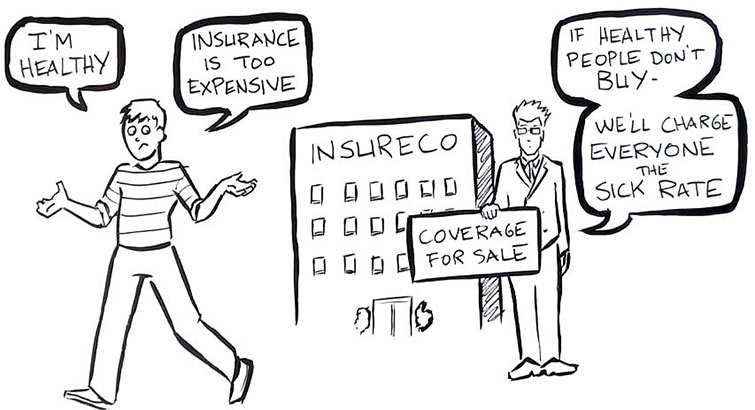
The implication here is that middle class people with low perceived health risk might prefer to remain uninsured and pay the penalty for violating the individual mandate. Reluctance among healthier and higher-income uninsureds is no surprise, but this paper appears to be the first to robustly measure the actual trade-off they would have to make in purchasing insurance.
Given that insured people use more than twice as much health care as uninsured people, it is not so hard to imagine that formerly uninsured people now have more responsibility for premiums and co-pays. But how did the authors conclude that the upsides of insurance – risk protection and actual services – are not enough to outweigh the financial burden and create “positive welfare” for newly insured people?
One reason is that most of the formerly uninsured were receiving some amount of free care (“bad debt” or “charity care”) before the individual mandate took effect. What’s changed is that people are on the hook for premiums and co-pays to receive that same care, plus other services that might not have been provided for free. The authors acknowledge that, for individuals who are low-income or at a high risk for expensive care, purchasing insurance can lead to improved welfare from additional health care services. Looking out across the entire group of uninsureds, though, the benefit of additional health care services does not appear to outweigh the increased financial burden, even with subsidies.
The surprising findings have sparked reaction from across the economic blogosphere. Matthew Martin from Separating Hyperplanes proposes one explanation: “the ACA is especially goofy in that much of the redistribution is confined to within the new individual market – even though people with employer-sponsored coverage are generally both wealthier and healthier. We have community rating within large employers and within the new individual market, but there’s no mechanism to redistribute between each of these pools.”
Writes Tyler Cowen from the blog Marginal Revolution: “I’ve read so many blog posts taking victory laps on Obamacare, but surely something is wrong when our most scientific study of the question rather effortlessly coughs up phrases such as […] ‘Average welfare for the uninsured population would be estimated to decline after the ACA if all members of that population obtained coverage.”
He continues, “the best thing to do is to improve it from within. Still, there are good reasons why it will never be so incredibly popular.”
For their part, Pauly, Leive and Harrington conclude: “It will be important to examine the level and pattern of these increased financial burdens to judge whether they are of sufficient social value to justify their imposition.”
 Imran Cronk